Silk Road Samarkand complex
Silk Road by Minyoun Samarkand
The most polished operation in the country
Explore Hotel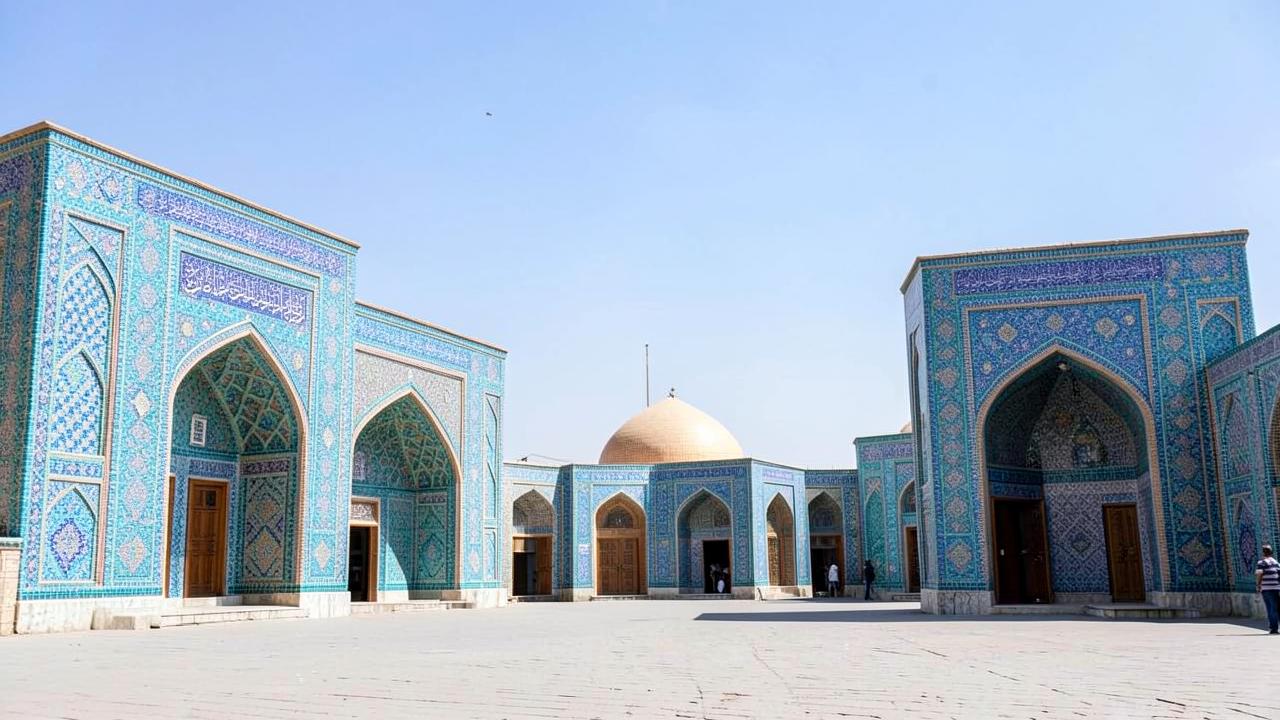

Samarkand and Bukhara, Uzbekistan
Three tiled madrasas facing one square, and a fifteenth-century ruler whose star catalogue Europe was still using two centuries later.
The places to stay
Silk Road Samarkand complex
The most polished operation in the country
Explore Hotel
Silk Road Samarkand complex
Central Asian craft and a gallery of the Nukus collection
Explore Hotel
Near Samarkand centre
A courtyard and pool closer to the Registan
Explore Hotel
Bukhara old town
A merchant's house with carved plaster and a roof terrace
Explore Hotel
By Happi · Last updated September 2026
A little local perspective
$$ to $$$ — roughly $120-350 a night, peaking in spring and autumn
The Registan is three madrasas facing each other across one square, built between the fifteenth and seventeenth centuries, their entire façades covered in glazed tile. The Ulugh Beg madrasa went up in the 1420s under a ruler who was also a working astronomer and built an observatory nearby with a forty-metre marble sextant cut into the bedrock. His star catalogue was accurate enough that European astronomers were still using it two centuries later.
That is Samarkand's proposition, and it is not a reconstruction argument in the usual sense — a great deal was restored under Soviet rule, sometimes heavily, and the tilework you see is a mix of original and replacement. It is still one of the great architectural sights on earth.
Uzbekistan received almost no leisure visitors until recently. Visa requirements were relaxed from 2018 for a long list of nationalities, and arrivals grew very fast from a base near zero.
Hotel stock has not caught up. What exists is mostly new, mostly built in the last few years, and concentrated in a purpose-built tourism complex outside Samarkand rather than in the historic centre. The boutique conversions that a European city of this stature would have are largely not there yet.
This is a destination arriving rather than arrived. The architecture is world class and the hospitality is a few years behind it, and it is worth knowing which is which before you go.
Samarkand has the Registan, the Gur-e-Amir where Timur is buried, the Shah-i-Zinda avenue of tombs and the Bibi-Khanym mosque.
Bukhara is the more intact one: a working old town of madrasas, trading domes and a tenth-century mausoleum, still lived in rather than presented.
Khiva, further west, is a walled city that has been preserved almost as an exhibit — extraordinary and slightly airless.
Tashkent is the capital, the arrival point, and has the metro stations that are worth a morning on their own.
The thing that makes a trip work is the Afrosiyob, a high-speed train running Tashkent to Samarkand in about two hours and on to Bukhara. It turned what used to be long desert drives into an easy sequence and it is the reason a week here is now comfortable.
The six below are grouped by city.
The Registan and the tombs.
Silk Road by Minyoun Samarkand occupies a building in the Silk Road Samarkand complex outside the centre, with a spa, several restaurants and the most polished operation in the country. It is a short drive from the monuments rather than among them.
Savitsky Plaza sits in the same development with a design that leans on Central Asian craft, a pool and a gallery of the Nukus collection.
Hotel Dilimah Premium Luxury occupies a smaller property nearer the historic centre with a courtyard, a pool and a shorter walk to the Registan.
The more intact old town.
Mercure Bukhara sits at the edge of the Bukhara old town with a courtyard, a pool and the trading domes a few minutes on foot.
Amelia Boutique Hotel occupies a converted merchant's house in the old town with a small room count, carved plasterwork and a roof terrace over the rooftops.
The capital and the arrival point.
Hyatt Regency Tashkent occupies a tower in central Tashkent with a spa, a pool and the most reliable facilities in the country, which matters at either end of a trip.
The small family guest houses across Bukhara and Khiva are excluded, and in both cities they are frequently in the most interesting buildings and cost very little. They are guest houses rather than hotels.
See the Registan twice, in early morning light and again after dark when the façades are lit. The square is the reason to come and it rewards a second look.
Walk Shah-i-Zinda, a narrow lane of tiled mausoleums climbing a hillside, at opening. It is the most beautiful thing in Samarkand and it is small enough to feel crowded quickly.
Spend two nights in Bukhara. It is the city people leave wishing they had given more time to, because it is lived in rather than visited.
Eat plov, which is the national dish and varies by city, and buy nothing in the first shop you enter.
Take the Afrosiyob rather than flying internally. It is fast, comfortable and it books out.
Tashkent is the main international gateway with connections through Istanbul, Dubai and several European cities. Samarkand and Bukhara both have small airports.
April, May, September and October are the best months. Summer regularly exceeds 40 degrees on the desert plain. Winter is cold and clear and the monuments are empty.
Check current visa arrangements before booking. They have been liberalised repeatedly and the list of exempt nationalities keeps changing.
A great deal was restored under Soviet rule, some of it heavily. The scale and the tilework are still remarkable.
Samarkand for the monuments, Bukhara for the intact old town. Most people end up preferring Bukhara.
New, thin and improving. The architecture is world class; the hospitality is a few years behind it.
Seven. Two in Tashkent either side, three in Samarkand, two in Bukhara.