


A little local perspective
Worth knowing.
Worth going.
- Destination
- Djerba and Sidi Bou Said, Tunisia
- The selection
- 7 hotels
- Your kind of trip
- history · value · beach · food
$$ to $$$ — roughly $150-450 a night, peaking in summer
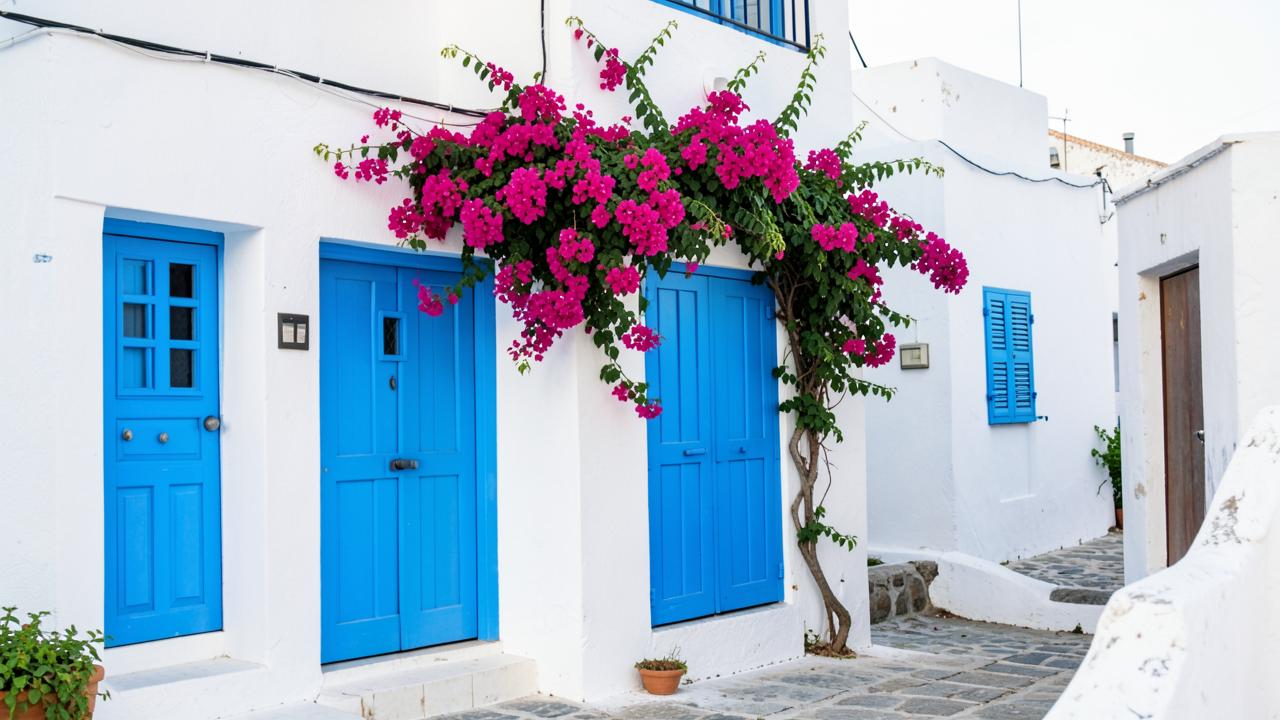
Sidi Bou Saïd is blue and white because a painter decided it should be. Rodolphe d'Erlanger, a French-British artist and musicologist from a banking family, settled in the village above Tunis around 1912, fell for the local architecture, and campaigned to have its palette protected. A municipal decree formalised it, and the village has been white with a specific cobalt blue on doors, shutters and ironwork ever since.
D'Erlanger built himself a palace there, Ennejma Ezzahra, and spent years documenting Arab classical music — his six-volume study is still cited. The house is now a museum of Arab instruments and the gardens look down over the Gulf of Tunis.
The blue is not decorative in origin either. The colour is traditionally made with a copper-based pigment thought to repel insects, which is why it appears on openings rather than walls.
Carthage
Down the hill are the remains of the city Rome destroyed in 146 BC after three wars, then rebuilt a century later as the capital of Roman Africa and the second city of the western empire. The Antonine Baths were among the largest in the Roman world; the Punic ports are still visible as two lagoons, one circular, which held a navy.
The site is UNESCO-listed and it is spread through a modern suburb, which is disconcerting until you accept that people have simply carried on living there.
The Bardo Museum in Tunis holds what is probably the finest collection of Roman mosaics anywhere, lifted from villas across the country.
Djerba
An island in the south, flat and dry, with olive groves and fortified mosques.
It also holds one of the oldest Jewish communities in the world. El Ghriba synagogue has stood on the site in some form since antiquity and the community's own tradition dates it to 586 BC, after the destruction of the First Temple. An annual pilgrimage brings visitors from across the diaspora. The synagogue was attacked in 2002 and again in 2023, and it is now under permanent armed protection.
Djerba as a whole was listed by UNESCO in 2023 for its settlement pattern — a landscape of dispersed courtyard farmsteads rather than villages, shaped by water scarcity.
Check current travel guidance for Tunisia before booking. Advice distinguishes sharply between the coastal north and the southern border regions.
The seven below run north to south.
Tunis and Sidi Bou Saïd
The capital and the blue village.
The Residence Tunis occupies a position at Gammarth on the coast north of Tunis with a spa, several pools and a thalasso centre. It is the best hotel in the country.
Four Seasons Hotel Tunis sits on the Gammarth coast with a spa, a pool and contemporary rooms.
Dar El Jeld Hotel & Spa occupies a set of restored houses inside the Tunis medina near the souks, with a courtyard and a rooftop over the roofs of the old city.
Villa Didon sits on the Carthage hillside with a small room count, a pool and views down over the ruins and the gulf.
Hammamet
The resort coast, an hour south.
La Badira occupies a beachfront position with an adults-only policy, a spa and a pared-back white interior.
Djerba
The southern island.
Radisson Blu Palace Resort & Thalasso, Djerba sits on the Djerba coast with a thalasso centre, several pools and a long beach.
Hasdrubal Prestige Thalassa & Spa occupies a beachfront estate with suites, a spa and full facilities.
What we have left off
The dar conversions in the Tunis medina and the menzel farmhouses on Djerba are excluded, and several are in genuinely historic buildings. They are guest houses rather than hotels.
What to do
Go to the Bardo for the mosaics and give it half a day. The scale and the preservation are extraordinary and it is not a crowded museum.
Walk Sidi Bou Saïd early, before the coaches, and go into Ennejma Ezzahra for the instruments and the garden.
See Carthage — the Antonine Baths, the Punic ports and the Byrsa hill — accepting that it is scattered through a suburb.
Take the train down to El Djem, where a third-century amphitheatre seating perhaps 35,000 stands almost intact in a small town, with very few visitors in it.
Eat brik, couscous and the harissa, which in Tunisia is its own cuisine rather than a condiment, and drink the mint tea with pine nuts.
Practical notes
Tunis has an international airport with good European connections; Djerba and Enfidha serve the resort coasts.
April, May, September and October are best. Summer is hot inland and busy on the coast. Winter is mild in the north and the sites are empty.
Check travel advice before booking and again before travelling; guidance varies significantly by region.
Every hotel bookable in Tunisia
Why is Sidi Bou Said blue and white?
A resident painter campaigned for it around 1912 and a municipal decree formalised the palette. The blue pigment was traditionally thought to repel insects.
What is at Carthage?
Punic and Roman remains including the Antonine Baths and the circular naval harbour, spread through a modern suburb and UNESCO-listed.
Is Djerba's Jewish community still there?
Yes, centred on El Ghriba synagogue, with an annual pilgrimage. It has been attacked twice this century and is under permanent protection.
How many nights?
Six. Three around Tunis and three on a coast.