


A little local perspective
Worth knowing.
Worth going.
- Destination
- The Faroe Islands
- The selection
- 4 hotels
- Your kind of trip
- landscape · walking · birdlife · photography
$$ to $$$ — roughly 200-450 euros a night, peaking June to August
When Google Street View had not reached the Faroe Islands, a local woman strapped a solar-powered camera rig to the back of a sheep and started photographing the roads herself. Sheep View 360 launched in 2016, generated exactly the attention it was designed to, and Google turned up with proper equipment the following year.
It tells you two useful things about the place. There are more sheep than people — around 70,000 to 54,000 — and the islands have an unusually dry sense of how to handle being overlooked.
Eighteen islands and no trees
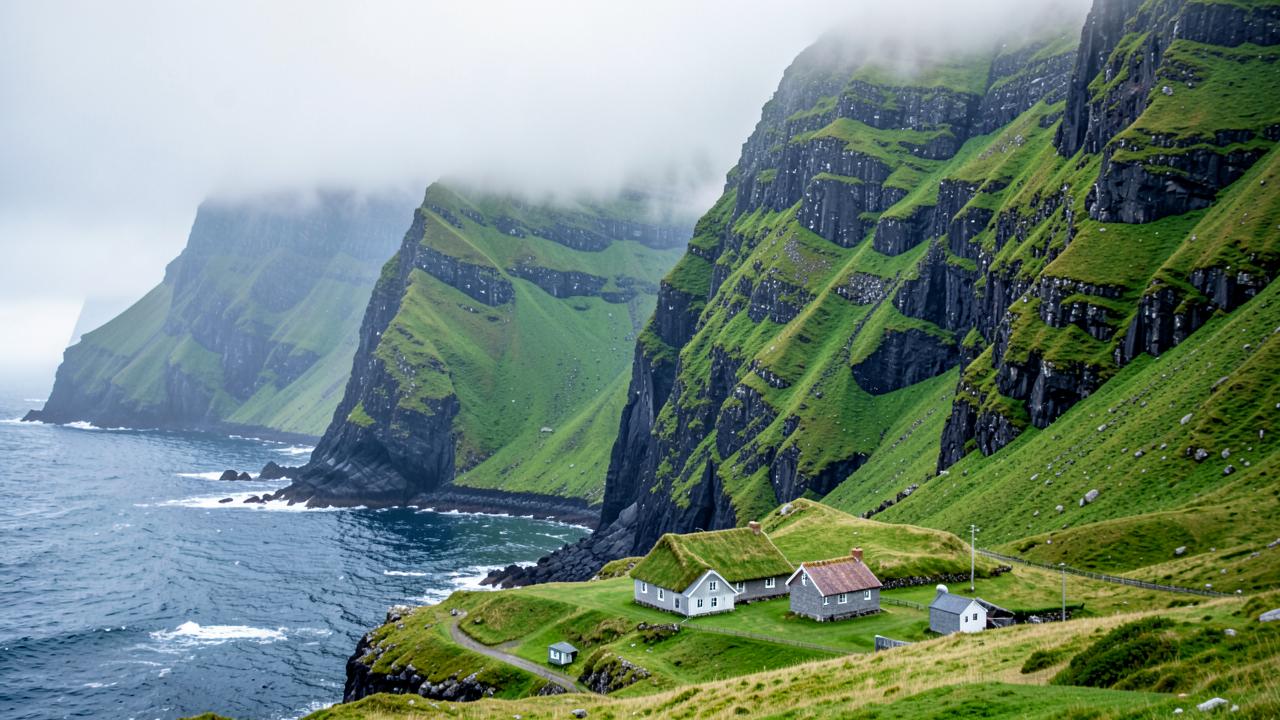
The Faroes sit in the North Atlantic between Scotland, Norway and Iceland: eighteen volcanic islands of layered basalt, steep-sided, green to the tops, connected by tunnels, ferries and causeways. Nowhere on any of them is more than about five kilometres from the sea.
There are essentially no trees. The combination of wind, salt and several centuries of sheep grazing removed them, and the few small plantations around Tórshavn are a recent and deliberate exception. The consequence is that the landscape is entirely legible — grass, rock, cliff, water, and buildings with turf roofs that were originally insulation and are now also a national aesthetic.
Two of the road tunnels run under the sea and one, opened in 2020, contains a roundabout on the seabed with a light installation in it. This is a country of 54,000 people that built an illuminated undersea roundabout, which is either absurd or admirable and is probably both.
The weather is the itinerary
Fog, wind and rain arrive without warning and clear as fast. It is common to have four distinct weather systems in a day, and a walk that is spectacular in the morning can be dangerous by noon.
Build slack into every plan. Ferries and helicopters to the outer islands are cancelled routinely, and the helicopter service — heavily subsidised as public transport, absurdly cheap, and one of the great flights in Europe — will not run in poor visibility.
The four below are all in or near Tórshavn, because that is where the inventory is.
Tórshavn
The capital, population around 13,000.
Hotel Føroyar occupies a hillside above the town with a turf roof, floor-to-ceiling glass facing the harbour and a restaurant that has done more than anything else to establish Faroese cooking as a serious proposition.
Havgrím Seaside Hotel 1948 sits on the harbour in a 1948 building, restored, with a small room count, a sauna and rooms over the water.
Hotel Brandan occupies a recent building in the centre with contemporary rooms, a good breakfast and the shortest walk to Tinganes, the turf-roofed government quarter on the promontory.
Hilton Garden Inn Faroe Islands sits near the town with reliable rooms, a restaurant and the most straightforward base for driving the islands.
What we have left off
The guest houses and self-catering cottages across the outer islands are excluded, and on Mykines, Kalsoy and Suðuroy they are essentially the only accommodation. If you want to sleep beyond Tórshavn, that is what you will be booking.
What to do
Walk to Kallur lighthouse on Kalsoy, reached by ferry and then a tunnel through the mountain, which is about forty minutes up to a headland with cliffs on three sides. It is the most photographed walk in the islands and it earns it.
Go to Mykines in summer for the puffins, which nest in enormous numbers on the western cliffs. The island has a visitor cap and a ferry that frequently does not run.
See Gásadalur, a village of fewer than twenty people with a waterfall dropping straight off the cliff into the sea beside it. Until a tunnel was cut in 2004 the only way in was over a mountain on foot, and the post was carried that way three times a week.
Take the helicopter. It runs as subsidised public transport, seats are cheap, and the route between islands at low level is extraordinary.
Eat at a heimablídni — home hospitality, where a family cooks dinner for visitors in their own house. It is a Faroese institution and it is booked directly.
Practical notes
Vágar airport has flights from Copenhagen, Reykjavík, Edinburgh and a handful of other cities, and is about forty-five minutes from Tórshavn through a subsea tunnel.
May to September has the long light and the birds. Summer temperatures rarely exceed 13 degrees. Winter is dark, wild and the outer islands become difficult.
A hire car is essential and the tunnels are tolled automatically by plate.
Every hotel bookable in the Faroe Islands
Are there more sheep than people?
Around 70,000 sheep and 54,000 people, and the word Faroe itself is usually traced to a root meaning sheep.
Why are there no trees?
Wind, salt and centuries of grazing. The small plantations near Tórshavn are recent and deliberate.
Can you reach the outer islands?
By ferry or subsidised helicopter, both weather-dependent and both cancelled often. Build slack into every plan.
How many nights?
Five. The weather will take at least one of them.