Haute-Ville terrace
Fairmont Le Chateau Frontenac
The 1893 copper-roofed chateau above the river
Explore Hotel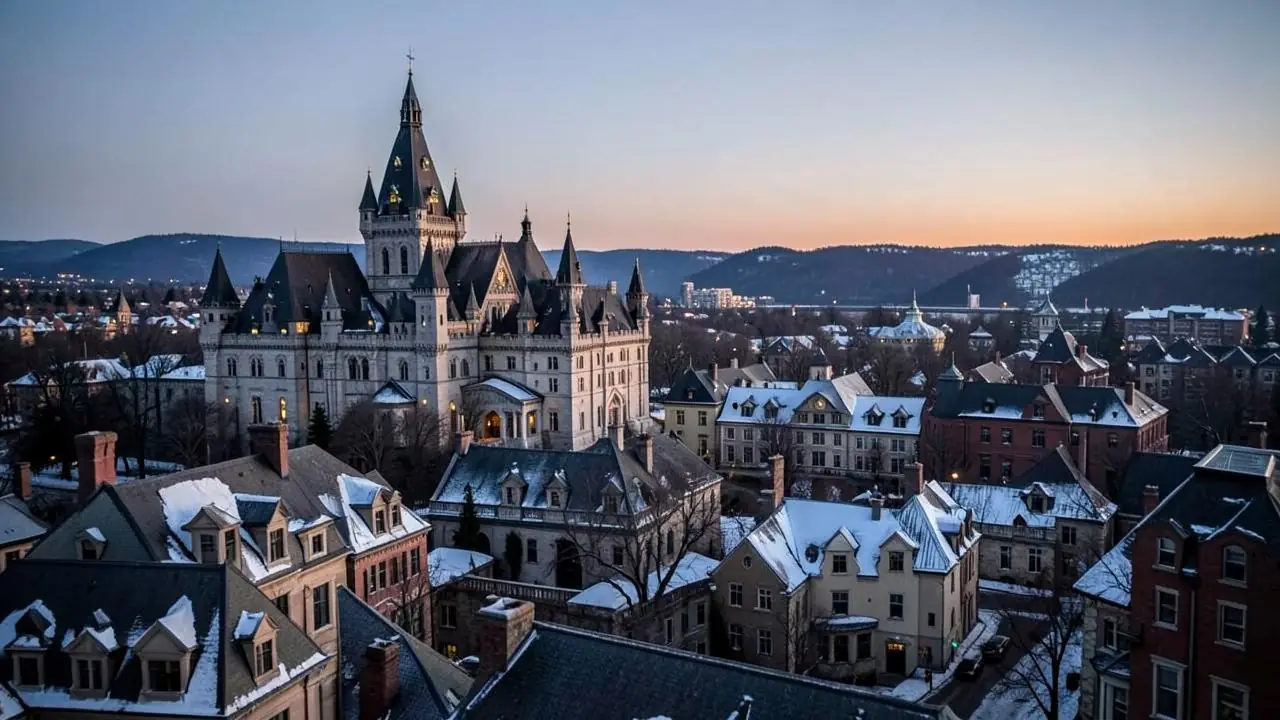

Quebec City, Canada
A hundred metres of cliff, a funicular and a staircase called Breakneck. In January that split stops being picturesque.
The places to stay
Haute-Ville terrace
The 1893 copper-roofed chateau above the river
Explore Hotel
Near Saint-Jean gate
Spa and indoor pool, best value inside the walls
Explore Hotel
Grande Allee, by the walls
Garden, pool and large rooms for families
Explore Hotel


By Happi · Last updated September 2026
A little local perspective
$$ to $$$$ — roughly C$250-700 a night, peaking in summer and at Carnaval
Quebec City is the only walled city north of Mexico, and the walls enclose an upper town on a cliff about a hundred metres above a lower town at the river's edge. The two are connected by a funicular that takes about a minute, by a staircase called the Breakneck Steps that is exactly as advertised, and by a road that loops around.
That vertical split is the geography of the whole visit, and in January, when the steps are iced and the wind comes off the St Lawrence, that split stops being scenery and becomes a daily calculation.
Haute-Ville, the upper town, is inside the fortifications: the Château Frontenac on its terrace, the Plains of Abraham, the seminary, the Citadelle and the Dufferin boardwalk with the river below. It is where the views are and where the winter carnival happens.
Basse-Ville, the lower town, is the older settlement: Place Royale, where Champlain landed in 1608, the Petit-Champlain shopping street, the antique dealers on Rue Saint-Paul and the port. It is more sheltered from the wind and it has the better restaurants.
They are a minute apart by funicular and about ten minutes on foot if you take the steps. Either works. What does not work is staying outside the walls in Saint-Roch or along the boulevard and walking up the hill twice a day in February.
The nine below are grouped by level.
Inside the walls, on the cliff.
Fairmont Le Chateau Frontenac is the most photographed hotel in the world, a copper-roofed château from 1893 on the terrace above the river, with six hundred rooms and a position that no other hotel in Canada approaches. Ask for a river-facing room; the courtyard rooms lose the entire point.
Le Monastere des Augustines occupies a former Augustinian monastery from 1639 beside the old hospital, still owned by the order, with a museum, a restrained interior and a policy of silence in the morning. It is the most unusual place to sleep in Canada.
Auberge Place d'Armes sits on Place d'Armes in a nineteenth-century building with a spa, a pool and a position between the château and the funicular.
Hotel Manoir Victoria occupies a set of joined buildings near the Saint-Jean gate with a spa, an indoor pool and the best value inside the walls.
Hotel Chateau Laurier Quebec sits opposite the Parliament just outside the Saint-Louis gate with a garden, a pool and large rooms. It is the family choice.
Hotel Clarendon occupies a 1930 art deco building on the edge of the old town with rooms that are the most restrained in the upper town.
Below the cliff, by the river, and out of the wind.
Auberge Saint-Antoine occupies a group of restored warehouses on the old port with archaeological finds from the site displayed in the walls of the rooms themselves, an excellent restaurant and the best hotel in the city. Each room contains an artefact excavated from beneath it.
Hotel 71 sits in a converted maritime warehouse on Rue Saint-Pierre with exposed stone, a spa and a design-led interior.
Hotel Le Germain Quebec occupies a building near Place Royale with contemporary rooms, a good restaurant and the shortest walk to the Petit-Champlain shops.
The hotels along Grande Allée and out toward Sainte-Foy are excluded. They are larger, cheaper and have parking, and they put a hill and a fifteen-minute walk between you and the only part of Quebec City that matters.
Walk the Dufferin Terrace and the Promenade des Gouverneurs along the cliff edge, then down the Breakneck Steps into the lower town and back up on the funicular.
Take the ferry to Lévis and back. It costs a few dollars, takes ten minutes each way, and the view of the city from the river is the best there is.
Montmorency Falls, fifteen minutes east, are higher than Niagara and almost nobody visits. In winter the spray freezes into a cone at the base that people climb.
Eat properly. Quebec's food is French-derived and distinctly its own, and the lower town has the best of it.
In winter, the Carnaval in February, the ice hotel north of the city, and skating on the terrace. In summer, the city is a completely different, lighter proposition.
Quebec City's airport is 20 minutes out. The train from Montreal takes about three hours and is the pleasant route.
June to October is warm and busy, with autumn colour in late September and October. December is beautiful and cold. January and February are properly cold, often below minus 15, and the city is entirely set up for it with underground passages and heated terraces.
French is the working language and English is widely understood in the tourist areas and less so beyond them.
Prices shown are sample rates from upcoming dates — not quotes for specific dates. Open a hotel and choose your own dates and guests to see the exact price.
Upper for the views and the château, lower for the restaurants, the shops and shelter from the wind. They are a minute apart by funicular.
It is the most convincingly European winter city in North America, and it is genuinely cold. Dress for minus 20 and it is remarkable.
For a river-facing room and the location, yes. It is a large hotel and the standard rooms are ordinary; the building and the position are what you are buying.
Three, or two paired with Montreal, which is three hours away.